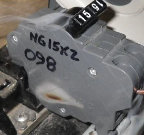
Photo: 15-Amp UBI Stab-Lok®
type breaker carrying 60 Amps (note smoking and charring)
fpe-info.org
A Non-commercial site dedicated to
ELECTRICAL & FIRE SAFETY
A Brief Summary of the Stab-Lok® Breaker Safety Problem
Federal Pacific Electric Co. (FPE) and other brands of Stab-Lok® circuit breakers do not reliably meet the functional requirements of the National Electrical Code (NEC). The Stab-Lok® panels should be replaced for fire and electrical safety reasons.
The defective performance of Stab-Lok® circuit breakers is summarized in the report Hazardous FPE Circuit Breakers and Panels. This report also provides information on FPE’s fraudulent testing and UL labeling practices, and on the consequences in terms of injuries, deaths, and property damage. There are no documented studies that contradict the conclusion that the Stab-Lok® circuit breakers have a high defect rate.
The defective performance of Stab-Lok® type circuit breakers includes failure to trip under moderate to severe electrical current overload. Some of them jam and do not trip at any current. Based on long-established and universally accepted engineering and fire safety fundamentals, circuit breakers that fail to trip properly when an overload or short circuit occurs increase the risk of fire and injury.
Circuit breakers are required to satisfy the NEC requirement for over-current protection for the circuits in a building. They must stop the current flow to wiring and equipment when hazardous over-current conditions occur. A circuit breaker functions as a switch that opens automatically (trips) to shut off power to a circuit when the current exceeds a preset level, minimizing the risk of fire.
Underwriters' Laboratories, Inc. (UL) establishes and publishes the accepted performance standard for circuit breakers (UL489) used in the branch circuits of residential and commercial buildings. By applying UL labels to its circuit breakers, FPE falsly certified that the breakers met the UL performance standards and were therefore suitable for the purpose as required by the NEC.
FPE Stab-Lok® circuit breakers were marketed and installed in buildings in the U.S.A. from the 1960s through the 1980s. The NEC requires that inspectors determine whether the installed equipment is “suitable for the purpose”. The presence of the UL label is taken as proof that they meet the UL and NEC performance requirements. Having been misled by FPE’s application of UL labels to substandard and defective product, local electrical inspectors approved those installations.
Fraudulent testing and labeling by FPE thwarted the honest effort of contractors and inspectors to install safe electrical systems. It was a serious breach of electrical safety standards.
© 2024 J. Aronstein
aronsteinj@verizon.net